|
|
|||||||||||||||||||||||
 |
||||||||||||||||||||||||
|
||||||||||||||||||||||||






















|
|
|
|
|
|
|
 |
||||||
 |
||||||
|
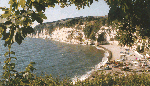
Beer is a village with a strong, but small-scale present day maritime tradition. It has a long history of fishing, with skills and business handed down from family to family. The sheer cliff coastline has become something of a distinguishing feature of this small town, with fishing and smuggling sharing equal importance in its heritage. A local hero of infamous reputation was Jack Rattenbury, a smuggler who turned his fortunes around by writing his memoirs in later life. The location of Beer village centre is stunning. It's tiny roadside brook runs the full length of the gently sloping streets, following the line of the pavement, until it flows into the sea. Although so much of the village's history has centered around the male fishing fleets, the women have also made a famous name for themselves as producers of lace. It is not surprising since Beer sits so close to Honiton, world famous home of lace-making in Victorian times. Beer's charm is that it is still a working fishing village.The steep cliffs that made such ideal hideouts for smugglers, also made ideal look-out locations for navigating yachts in the area. The bay itself is very sheltered and has therefore become a sun trap for visiting tourists. They are protected from the wind by the sheltered bay, but have the picturesque accoutrements of the fishing industry like bright wooden boats, winches and old rope around them. The daily fishing trips have enabled the Anchor Inn, perched on top of the cliff, to gain something of a reputation as a specialist fish restaurant. Arguably Beer's finest and most well known attraction are the underground caves, lying hidden beneath the chalk cliffs. The Beer Quarry Caves, as their name suggests, are a feat of man's handiwork. Carved out by hand, they present the visitor with vast, high roofs and airy, inspiring caverns. Perhaps part of the reason that the caves were quarried or perhaps because of the quarrying, Beer stone appears on sections of some of Britain's most highly prized and historic monuments, including Buckingham Palace. Another favourite with visitors is the nearby Pecorama, a miniature steam railway with its own station. Memorabilia has been utilised from some of East Devon's old key stations like Sidmouth and Seaton.
|
||||||
|
HISTORY The origin of the name of Beer is uncertain. Various theories have been put forward as to its origin. Bearu - Saxon for "Wood" Byr - Norse for "farmstead" Bere - Anglo-Saxon for "barley" The Saxon version has been given as "Beerham" or "Berham" In Norman times the name was spelt "Bera" as it appears in the Domesday Book. In a petition sent to parliament in 1698 appealing against the repeal of the 1697 Act granting English lace makers protection from foreign competition, Beer is referred to as Beare. King HenryVIII's antiquarian, John Leland, referred to the village as Brereworde when he was travelling the country in the 16th century collecting historical and geographical data. Other variations that appear through the years are Bereword, Bere, Ber.
The Manor. Before the Norman Conquest the manor belonged to the abbey of Horton, which was annexed in 1122 with all its possessions to the Abbey of Sherborne. What is now the Common Lane allotments was once the Vineyards where the abbots grew vines for making wine. After the dissolution, King Henry VIII included it in the dowry of Catherine Parr. Later the manor was sold to the Hassard family of Lyme Regis who sold the estate to John Starr of Beer in 1550.. A part of the manor was afterwards sold to the father of Sir William Pole, the historian,who himself sold it to John Walrond of Bovey, who, around 1630 , became owner of the whole of the manor. Judith Maria, the heiress of the Walronds married Lord John Rolle in 1778 when the manor became the property of the Rolle's. Lord John married a second time, in 1822, to Louisa Barbara Clinton. On the death of Lord Rolle, the estate passed to the nephew of his second wife, Mark Clinton, who changed his name to Mark Rolle. In 1820 the almshouses were built and the school in Beer was founded under a Trust set up by Lord Rolle in memory of his wife, Judith Maria who had died the previous year. The Trust also provided a pension for the poor who were to live in the almshouses. Book of the Axes, George Pulman.
The Plague. In the 17th century, three-quarters of the population of Beer died in the bubonic plague. As there was insufficient space in the chapel graveyard, those killed by the plague were buried in a field at Holyhead. In the Church there is a tablet which reads: "John, the fifth son of William Starr, of Bere, gent., & Dorothy his wife, which died in the Plague, was here buried. 1646.". This memorial was retained from the Chapel previously on the site.
The Pier. According to Leland, King Henry VIII's antiquarian, in the 16th century an attempt was made to build a pier, but a storm smashed the pier to pieces.
Wars. Napoleonic Wars. Two thirty-pounders were sited on Gun Cliff. and another ten guns were placed at Beer Head with a hut for the men that worked them. One night part of the cliff at Beer Head fell away taking the ten guns and hut with it. Fortunately nobody was on duty at the time. In February 1918 a seaplane was stranded on the beach. In March 1918, a French ship was torpedoed in the bay and 15 survivors landed on Beer beach.
Spaniards. To neighbouring villages, residents of Beer, may sometimes be referred to as Spaniards. Tradition has it that a Spanish vessel was wrecked off the shore and that the crew settled in Beer which was thinly populated owing to the plague. Whether the crew was from a ship of the Spanish Armada or a merchant ship which was wrecked in Beer Cove towards the end of the 17th century, is unclear.
Chapel of Rest. The Chapel of Rest in the Clapps Lane graveyard was built in 1866.
|
||||||